Searches and multimessenger astronomy
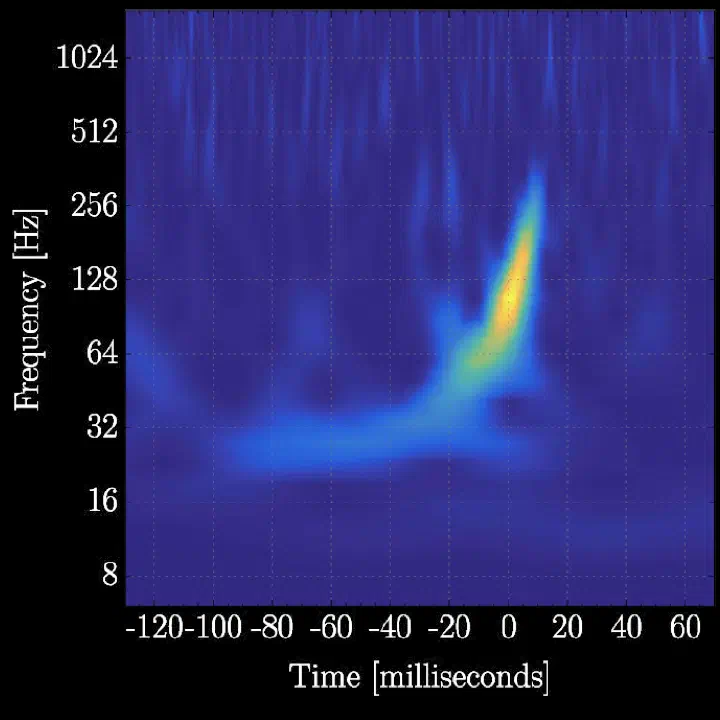
Gravitational-wave signals are buried in detector noise that is neither stationary nor Gaussian: short bursts of non-astrophysical noise, or “glitches,” can mimic or mask real signals. Detecting compact-binary mergers reliably takes matched-filter searches that cover a wide range of masses and spins, methods for suppressing noise artifacts, and careful estimates of how often noise alone would produce a candidate as significant as the one observed.
I have worked on these problems since before the first detection, including leading the effort to extend the templated search used by Advanced LIGO to spinning, high-mass binaries, a key step in detecting GW150914. I continue to work on improving search sensitivity, for example to the short signals from intermediate-mass black holes, and on open catalogs of gravitational-wave events built from public data, such as the Open Gravitational-wave Catalog (OGC).
Many astrophysical events should produce both gravitational waves and light. Some will be too weak to stand out in either a gravitational-wave or an electromagnetic search on its own, but can be found by combining the two. I develop methods for these joint, sub-threshold multimessenger searches, such as searches for gamma-ray bursts that coincide with gravitational-wave candidates.
Recent papers
- Mining the Alerts: A Preliminary Catalog of Compact Binaries from the Fourth Observing Run
- Ameliorating transient noise bursts in gravitational-wave searches for intermediate-mass black holes
- Estimating false alarm rates of sub-dominant quasi-normal modes in GW190521
- Search for Coincident Gravitational Waves and Long Gamma-Ray Bursts from 4-OGC and the Fermi-GBM/Swift-BAT Catalog
- 4-OGC: Catalog of Gravitational Waves from Compact Binary Mergers
- 3-OGC: Catalog of Gravitational Waves from Compact-binary Mergers