Next-generation detectors and cosmology
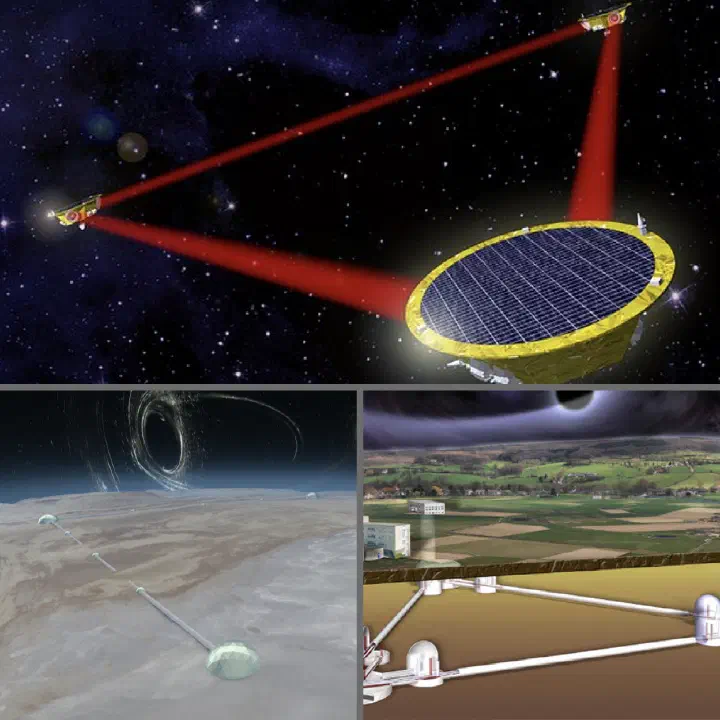
The next generation of gravitational-wave observatories will transform the field. On the ground, Cosmic Explorer in the United States and the Einstein Telescope in Europe are designed to be about ten times more sensitive than today’s detectors, enough to observe nearly every binary black hole merger in the universe. In space, LISA will observe at lower frequencies, opening a window onto massive black hole binaries and onto stellar-mass binaries years before they merge in the sensitive band of ground-based detectors.
These observatories promise precision tests of general relativity, new measurements of dense matter, and a census of compact objects across cosmic history. They also bring new challenges: overlapping signals, very long signals, enormous catalogs, and computational demands far beyond those of current analyses. I study what these detectors will be able to learn and develop the analysis methods they will need, work that also helps inform how the detectors are designed. I am a member of the Cosmic Explorer Consortium and a Core Member of the LISA Consortium.
Gravitational waves also offer a way to measure the expansion of the universe. Because a gravitational wave directly encodes the distance to its source, merging binaries act as standard sirens. Combined with redshift information, from an electromagnetic counterpart, a catalog of potential host galaxies, or the source population itself, they give a measurement of the Hubble constant that is independent of other methods. With next-generation detectors, these measurements could probe cosmic expansion out to high redshift.