Neutron stars and dense matter
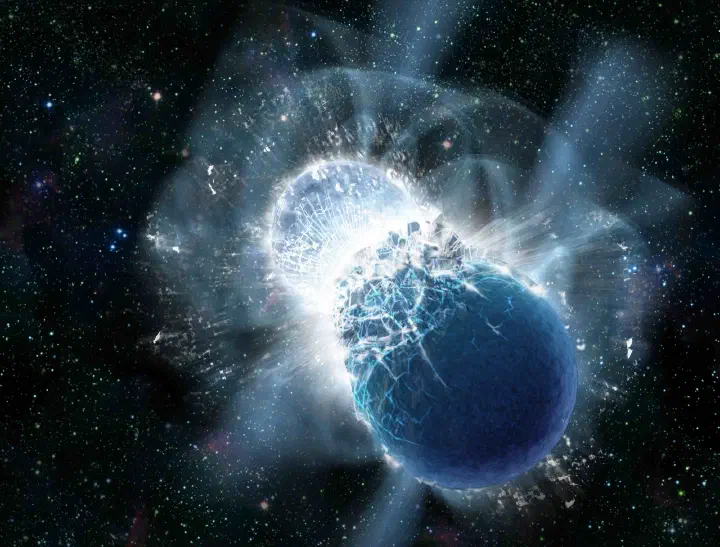
The cores of neutron stars hold the densest matter in the observable universe. At these densities, and the relatively low temperatures inside a neutron star, matter is governed by quantum chromodynamics, but first-principles calculations are out of reach and laboratory experiments cannot recreate these conditions. Neutron stars are therefore a unique window onto the physics of dense nuclear matter, and possibly onto new phases of matter.
The microphysics of a neutron star, summarized by its equation of state, determines its large-scale properties: the relation between its mass and radius, and how much it deforms in the tidal field of a companion. These properties leave an imprint on the gravitational waves emitted when two neutron stars, or a neutron star and a black hole, spiral together and merge, and on the light that can follow the merger.
I work on combining these observations with nuclear theory to constrain the equation of state. This includes joint Bayesian analyses of gravitational-wave data and X-ray observations of pulsars, inference of nuclear-physics parameters directly from gravitational-wave data, and fast emulators that make these analyses computationally practical. A related question is how well gravitational waves alone can tell a neutron star from a black hole.
Recent papers
- Direct inference of nuclear equation-of-state parameters from gravitational-wave observations
- Toward Accelerated Nuclear-physics Parameter Estimation from Binary Neutron Star Mergers: Emulators for the Tolman–Oppenheimer–Volkoff Equations
- Reproducing the results for NICER observation of PSR J0030+0451
- Using Gravitational Waves to Distinguish between Neutron Stars and Black Holes in Compact Binary Mergers
- Stringent constraints on neutron-star radii from multimessenger observations and nuclear theory