Bayesian inference and open-source software
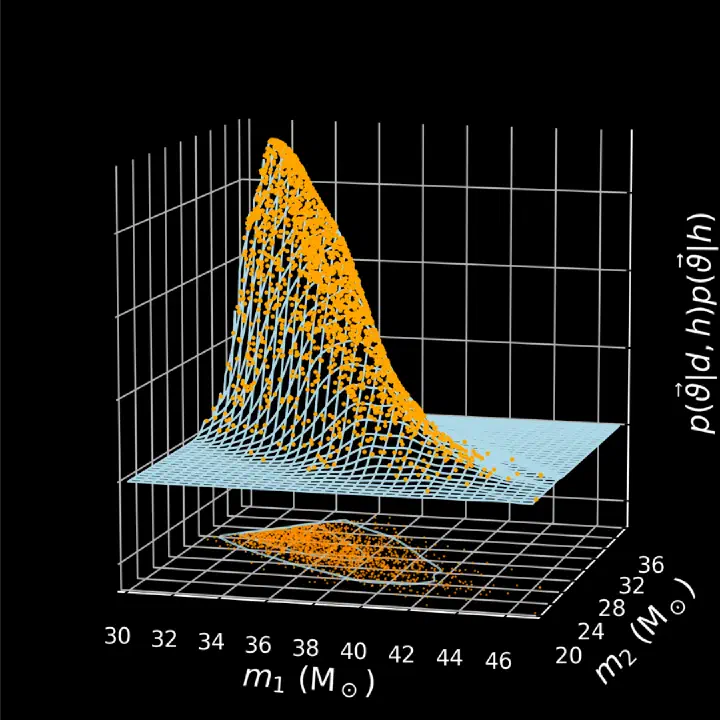
Every scientific result from a gravitational-wave observation, whether the masses and spins of black holes, the radius of a neutron star, or a test of general relativity, rests on inferring the properties of the source from noisy data. This is a problem of Bayesian inference: computing the probability distribution of the source’s parameters given the data and models of the signal and noise.
I am a lead developer of PyCBC Inference, an open-source Python toolkit for gravitational-wave parameter estimation that is part of the broader PyCBC package and is used by many groups for their own research. My work in this area aims to make inference faster, more robust, and more flexible: marginalizing over nuisance parameters such as time and sky location, extracting more information from signals seen across multiple frequency bands, using emulators to speed up expensive models, and building samplers designed for parallel computing.
Open-source software is central to how I do science. As Director of Syracuse University’s Open Source Program Office, I also work to support open-source research software across the university.
Recent papers
- Direct inference of nuclear equation-of-state parameters from gravitational-wave observations
- Multiband parameter estimation with phase coherence and extrinsic marginalization: Extracting more information from low-SNR CBC signals in LISA data
- Toward Accelerated Nuclear-physics Parameter Estimation from Binary Neutron Star Mergers: Emulators for the Tolman–Oppenheimer–Volkoff Equations
- Sky marginalization in black hole spectroscopy and tests of the area theorem
- Reliability of parameter estimates in the first observing run of Advanced LIGO
- Posterior samples of the parameters of binary black holes from Advanced LIGO, Virgo’s second observing run