Black holes and tests of gravity
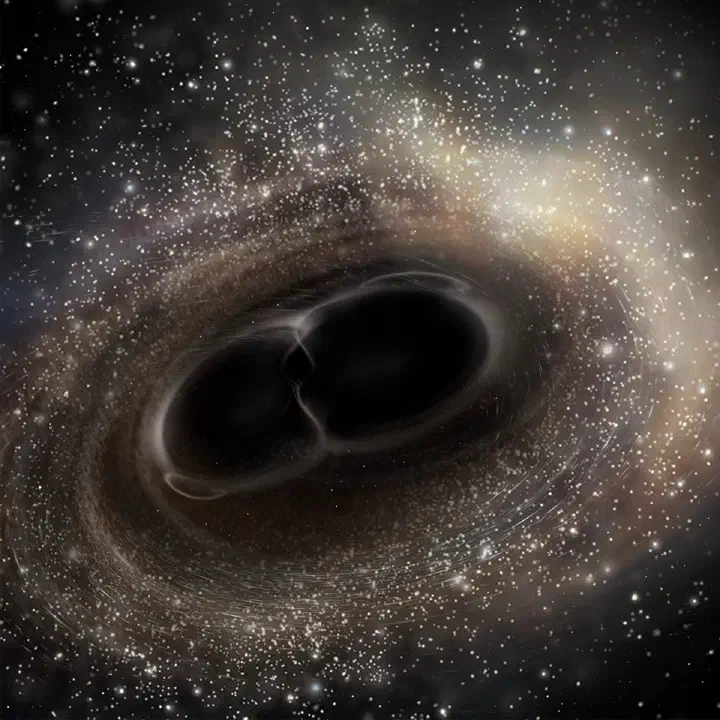
Binary black holes are natural laboratories for gravity in its most extreme form. When two black holes merge, they form a single, highly distorted black hole that settles down by radiating gravitational waves. This ringdown is made up of a spectrum of quasinormal modes. In general relativity, the no-hair theorem says that the frequency and damping time of every mode is set by just two numbers: the final black hole’s mass and spin. Measuring more than one mode, known as black-hole spectroscopy, is therefore a direct test of whether the remnant is the Kerr black hole that general relativity predicts.
My collaborators and I develop methods to detect and characterize these modes in real data, and to understand the statistical and systematic uncertainties that come with them, such as how uncertainty in the arrival time and sky location of a signal affects what can be said about its ringdown. We also look for other signatures of new physics: tests of Hawking’s area theorem, which says that the total horizon area cannot decrease in a merger; searches for “echoes” and other signs of horizonless compact objects; and tests of the post-Newtonian description of the inspiral.
These tests grow more powerful as detectors become more sensitive and the number of observations grows. Exceptionally loud events, and results combined across many events, provide some of the most stringent tests of general relativity available.
Recent papers
- Potential science with GW250114 – the loudest binary black hole merger detected to date
- Hierarchical constraints on gravitational waves from horizonless compact objects
- Sky marginalization in black hole spectroscopy and tests of the area theorem
- Low evidence for ringdown overtone in GW150914 when marginalizing over time and sky location uncertainty
- Gating-and-inpainting perspective on GW150914 ringdown overtone: Understanding the data analysis systematics
- Spectroscopy for asymmetric binary black hole mergers