Research Interests
My research uses gravitational waves, ripples in spacetime produced by the most violent events in the universe, to study black holes, neutron stars, and gravity itself. I am a member of the Syracuse University Center for Gravitational Wave Astronomy and Astrophysics. Each area below has a short overview and a list of my most recent papers on the topic.
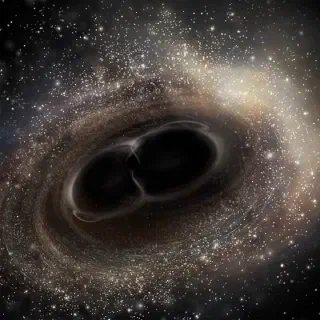 Black holes and tests of gravity
Using the gravitational waves from merging black holes to test general relativity and the nature of black holes.
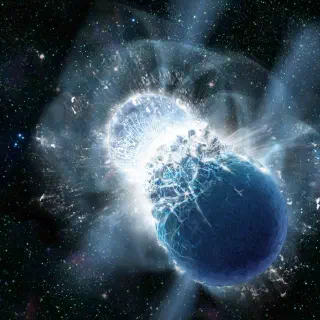 Neutron stars and dense matter
Combining gravitational-wave and electromagnetic observations of neutron stars to learn how matter behaves at extreme densities.
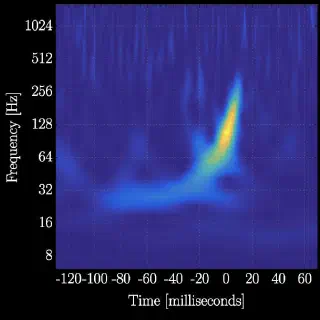 Searches and multimessenger astronomy
Finding gravitational-wave signals in noisy detector data, measuring their significance, and searching for joint signals with telescopes.
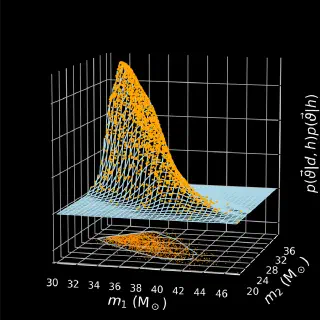 Bayesian inference and open-source software
Developing the statistical methods and open-source tools used to infer the properties of gravitational-wave sources.
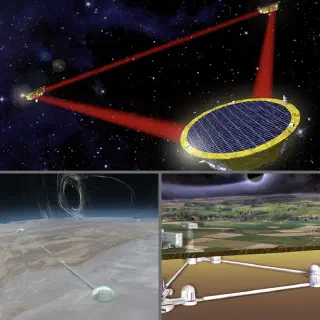 Next-generation detectors and cosmology
Preparing for the science and data-analysis challenges of future observatories such as Cosmic Explorer, the Einstein Telescope, and LISA.
Software
- PyCBC
- Open-source software for gravitational-wave data analysis, used to detect and characterize compact-binary mergers. I am a lead developer of its parameter-estimation toolkit, PyCBC Inference.
- pykerr
- Quasinormal-mode frequencies, damping times, and spheroidal harmonics of Kerr black holes.
- epsie
- An embarrassingly parallel Markov chain Monte Carlo sampler for Bayesian inference.